Ribs on a Pellet Grill: 3-2-1, 2-2-1, and Why I Stopped Wrapping
How to cook ribs on a pellet grill: what 3-2-1 actually does, why it overcooks baby backs, real cook times for spares and baby backs, and how to call a rack done with the bend test.
 By Oleg Galeev, cooking on pellet grills since 2020, runs the OleGrill YouTube channel
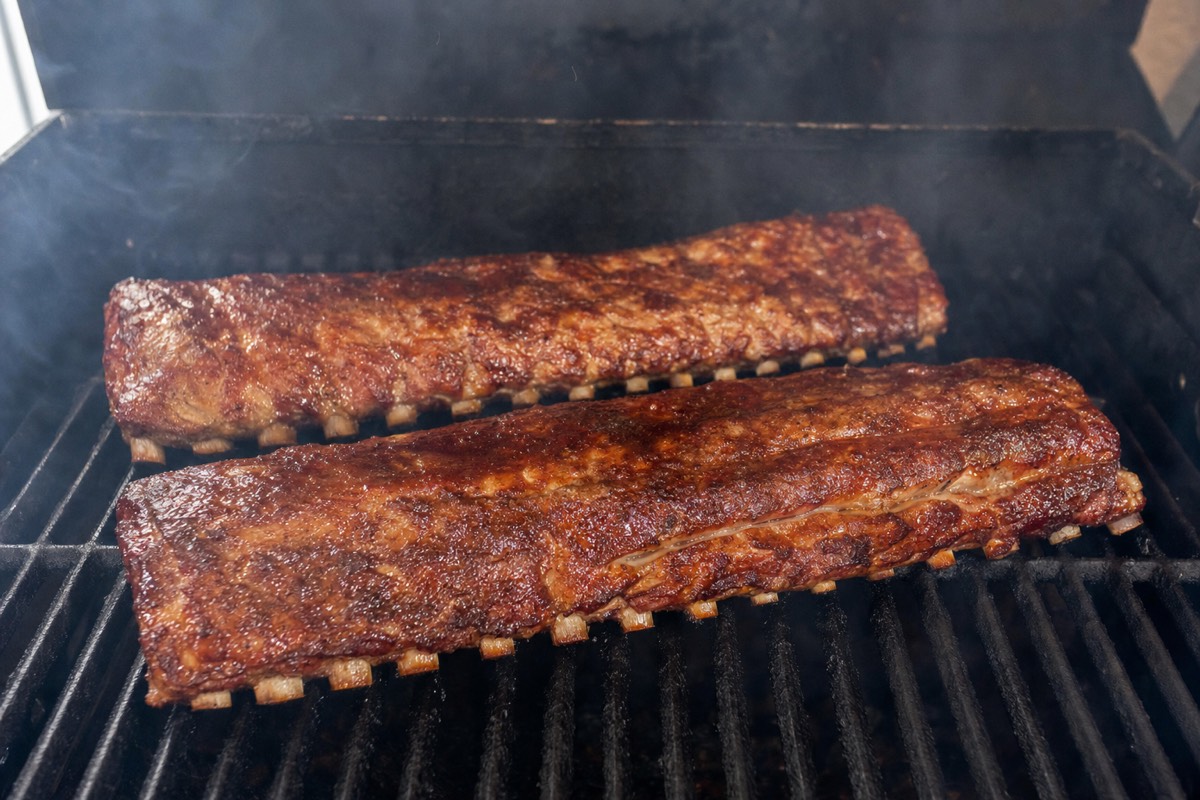
Short answer
Run the pellet grill at 225°F. Spare ribs take about 6 hours and can handle the classic 3-2-1 wrap schedule. Baby backs are lighter and finish in 4.5 to 5.5 hours, so use 2-2-1 or skip the wrap. The rack is done when it bends about 90 degrees and the bark cracks, usually high 190s internal.
Live prices. Affiliate links: we may earn a commission at no extra cost to you. How this works.
The first rack of baby backs I ran 3-2-1 on came off the grill looking perfect and falling apart in my hands before I could get a knife to it. Bones slid clean out of the meat. My father-in-law loved it. I didn't, because that texture is pot roast wearing a bark costume, and I had just spent six hours making it. That cook, back in 2021, is why this page exists. I have smoked a lot of racks since then, on every pellet grill in our test rotation, and the honest answer about 3-2-1 is more complicated than the recipe cards let on.
What is the 3-2-1 method for ribs?
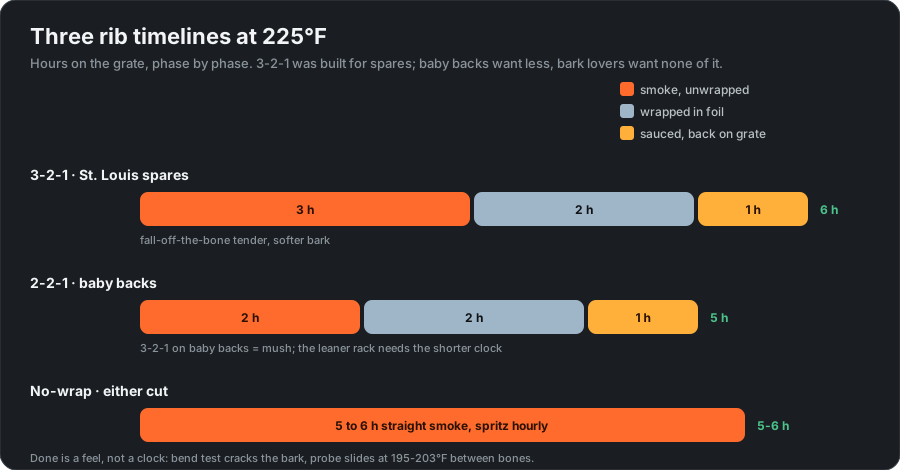
3-2-1 means 3 hours of smoke at 225°F, 2 hours wrapped in foil with a splash of liquid, then 1 hour unwrapped to set the sauce and firm the bark. Six hours total. It was built for full-size spare ribs, and on spares it works. On smaller racks it overcooks.
The logic is sound. The first block builds smoke flavor and bark. The foil stage braises the rack in its own juices, pushing it through the tough collagen phase fast. The final hour dries the surface back out so you are not serving wet, steamed ribs.
Here is the part the recipe cards skip: those numbers were tuned for a 3-pound-plus rack of spares with real thickness to it. Feed the same six hours to a lean 2-pound rack of baby backs and the foil stage takes them past tender into mush. Fall-off-the-bone sounds like a compliment. Competition judges score it as overcooked, and once you taste a rack with a slight tug left in it, you will agree with them.
The wrap also costs you bark. Foil is a steam environment, and steam softens the crust you spent three hours building. The final unwrapped hour recovers some of it, never all of it. When I want the crust I get on a brisket, dark and set and almost crunchy at the edges, I skip the foil completely and just ride the rack to tender. It takes longer. It is worth it.
| Method | Schedule at 225°F | Total time | Texture | Bark |
|---|---|---|---|---|
| 3-2-1 | 3 hr smoke, 2 hr foil, 1 hr set | 6 hr | Fall-off-the-bone, soft | Softened by foil, partly recovered |
| 2-2-1 | 2 hr smoke, 2 hr foil, 1 hr set | 5 hr | Tender with light tug | Moderate, better than 3-2-1 on small racks |
| No-wrap | Straight smoke until the rack bends | 5-6+ hr | Bite-through with clean pull | Best of the three, dark and fully set |
My default: 3-2-1 only for big spares when the crowd wants fall-apart ribs, 2-2-1 for baby backs, no-wrap whenever the schedule allows.
What is the 3-3-3 rule for ribs (and why it is NOT the same thing)?
The 3-3-3 rule is not a rib schedule at all, despite how often it gets pasted into rib threads. Every version I have seen is either a garbled copy of 3-2-1 stretched to nine hours, which would wreck any rack, or a food-storage guideline that has nothing to do with your smoker.
This one earns its own section because people type "3-3-3 ribs" into search bars constantly, and the answers floating around are a mess. Some posts present it as 3 hours of smoke, 3 hours wrapped, 3 hours sauced. Run that math: nine hours at 225°F on a rack that needs five or six. Even a heavy rack of spares would be past falling apart, into the zone where the meat squeezes to paste. Baby backs would be unservable.
Other uses of "3-3-3" have nothing to do with cooking. You will find it attached to refrigerator storage advice and to portioning rules of thumb. None of that tells you when to wrap a rack.
So when a forum post or an AI answer hands you 3-3-3 as a rib method, treat it as a typo of 3-2-1 that grew legs. The numbers in 3-2-1 are not sacred either, they are a starting point for one specific cut at one specific temperature. But at least that schedule was designed on purpose. If you remember one thing from this section: the total cook should land near 5 to 6 hours at 225°F, and any "rule" that pushes a standard rack past that is a rule someone made up in a comment section.
How long do ribs take on a pellet grill?
At 225°F, plan on 5 to 6 hours for spare ribs and 4.5 to 5.5 hours for baby backs, wrapped or not. Bumping to 250°F trims roughly an hour. These are windows, not deadlines: the rack is done when it bends and probes tender, not when the timer goes off.
Thickness drives the spread. A 3.5-pound rack of St. Louis spares carries a lot more meat over the bone than a 1.5-pound rack of baby backs, and collagen needs both temperature and time to break down. That is why I weigh racks at the store and why the meatier rack always goes on first when I am running two.
Pellet grills bring one honest weakness to a rib cook: mild smoke. A pellet fire burns clean and efficient, which is great for temperature control and thin on smoke flavor, and a baby back cook gives you barely four hours to build any. Ribs take smoke mostly in the first stretch, so a short cook plus a light-smoking cooker can produce ribs that taste more roasted than barbecued. This is exactly the cook where the Camp Chef Woodwind Pro earns its spot in my rotation. Its Smoke Box burns real wood chunks alongside the pellet fire, and the difference on a short rib cook is not subtle. You can check the current price, and see how it stacked up against the whole field in our pellet grill rankings.
If you are cooking on a standard pellet grill instead, run the first hour or two at 180-200°F. Lower pit temperatures produce more smoke on these cookers, and the extra time in the smoke zone shows up in the finished rack. Just add that time to your total.
Baby backs or spare ribs on a pellet grill?
Spares, if you are asking me. They carry more fat, more connective tissue, and more forgiveness, which suits a long pellet cook. Baby backs are leaner, cook faster, and punish an extra 45 minutes of foil. They also usually cost more per pound for less meat.
Baby backs come from up near the loin: short, curved, lean. St. Louis spares are cut from the belly side, trimmed square, with flat bones and more marbling. That fat is insurance. When my pit runs hot for an hour because I got distracted, spares shrug it off. Baby backs turn dry.
Country style ribs are the odd one out because most of them are not ribs at all. They are strips cut from the shoulder end, closer kin to the pork butt I break down in my pulled pork guide than to anything with a rack of bones. Cook them like shoulder, not like ribs.
| Cut | Raw weight | Time at 225°F | Character | Best method |
|---|---|---|---|---|
| Baby back | 1.5-2.5 lb per rack | 4.5-5.5 hr | Lean, tender, mild | 2-2-1 or no-wrap |
| St. Louis spare | 2.5-3.5 lb per rack | 5-6 hr | Fatty, meaty, big pork flavor | 3-2-1 or no-wrap |
| Country style | Sold by the piece, no rack | 3-4 hr to 195°F+ | Shoulder meat, shreddable | Smoke, then wrap or braise |
Feeding a crowd? A rack of spares feeds two to three adults, a rack of baby backs closer to two. I always cook one more rack than the math says. Leftover ribs have never once been a problem at my house.
How do you know when ribs are done?
Pick the rack up with tongs at one end and let it bend. When it folds around 90 degrees and the bark cracks on the surface, it is ready. That usually lines up with an internal temperature in the high 190s to low 200s in the meat between the bones.
Time tells you when to start checking. It never tells you when to pull. Two racks from the same pig can finish 45 minutes apart, so I lean on three checks and let them vote.
| Doneness check | How it works | Reading it | Weak spot |
|---|---|---|---|
| Bend test | Lift the rack from one end with tongs | ~90 degree bend, bark cracks | Takes reps to judge; small racks bend easier |
| Toothpick / probe | Slide a probe between bones | Goes in like soft butter, no resistance | Must test between bones, not against bone |
| Internal temp | Thermometer in the meat between bones | High 190s to low 200s °F | Thin meat, bones nearby, readings jump around |
A note on that temperature, because it confuses people. The USDA safe temperature chart lists 145°F as the safe minimum for fresh pork. Ribs are safe long before they are good. At 145°F the collagen has barely started to melt and the rack chews like a tire. The extra 50 degrees are not about safety, they are about turning that connective tissue into the gelatin that makes ribs eat like ribs.
My routine: start bend-testing spares at hour five, baby backs at hour four. If the rack bends but the probe still catches, give it 30 more minutes and check again. Patience at this stage is the whole game.
Do country style ribs get more tender the longer they cook?
Shoulder-cut country style ribs do, up to a point. They are laced with collagen that melts across the 180s and 190s, so pushing them to 195-205°F internal makes them dramatically more tender. Loin-cut versions are the trap: lean meat only dries out with extra time.
Flip the package over before you buy. Heavy marbling and irregular seams mean shoulder, and shoulder is what you want for the smoker. Those pieces behave like miniature pork butts. Smoke them at 225-250°F, take them past 195°F internal, and the connective tissue that made them chewy at 160°F turns silky. If they still feel tough, the answer is almost always more time, not less heat. Wrapping them in foil with a little liquid for the last stretch speeds this up the same way it does on a full pork butt.
Pale, uniform, lean pieces are loin. There is no collagen payoff waiting inside them, so "longer equals more tender" fails completely. Cook those hot and fast to a touch above the USDA minimum of 145°F with a rest, treat them like thick chops, and they are genuinely good. Take them to 200°F and you get sawdust.
This is the same collagen logic that governs every low-and-slow cook on this site, and it is why the tough, cheap, ugly cuts are the ones that reward a pellet grill. The full breakdown of how we run these tests, same pellets, logged pit temps, repeated cooks, is on our how we test page.
Should I remove the membrane from ribs before smoking?
Yes. The papery membrane on the bone side turns leathery on the smoker and blocks smoke and rub from reaching the meat. Slide a butter knife under it at one end, grip it with a paper towel, and peel it off in one sheet. Takes thirty seconds once you have done it twice.
What temperature should I set my pellet grill for ribs?
225°F is the standard and what every schedule on this page assumes. 250°F works and saves about an hour, with slightly less smoke flavor. If your pellet grill smokes lightly, run the first hour or two at 180-200°F for extra smoke, then finish at 225°F.
Can I do 3-2-1 ribs at 250°F instead of 225°F?
Not with the same numbers. At 250°F everything moves faster, so a full six hours will overshoot. Compress the schedule toward 2-2-1 and lean on the bend test rather than the clock. The stages still work, the timings just shrink.
Do I need to spritz ribs on a pellet grill?
No, and I usually skip it on wrapped cooks since the foil handles moisture anyway. On no-wrap cooks a spritz of water or diluted apple juice every 45 minutes after the first hour keeps the surface from drying and helps smoke stick. It also cools the pit each time you open the lid, so do not overdo it.
How many racks of ribs do I need per person?
Figure half a rack of spares or a bit more than half a rack of baby backs per adult. Racks vary, baby backs run 1.5 to 2.5 pounds and St. Louis spares 2.5 to 3.5 pounds raw, and roughly half that weight is bone and trim loss. When in doubt, add a rack.