Smoking a Turkey on a Pellet Grill: Times, Temps, and the Skin Problem
Real pellet grill turkey timing at 225, 275, and 325, whole vs spatchcock numbers, brine trade-offs, and the USDA temperatures that make a smoked bird safe.
 By Oleg Galeev, cooking on pellet grills since 2020, runs the OleGrill YouTube channel
Short answer
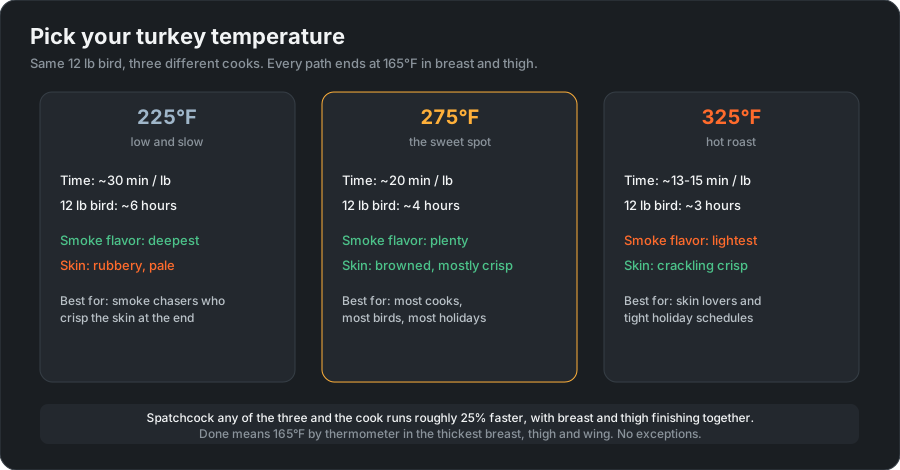
Plan on 30 to 35 minutes per pound at 225, about 20 to 25 at 275, and 13 to 15 at 325. I smoke turkey at 275 to 300 for skin you can actually eat, spatchcock anything over 12 pounds, and pull the bird when breast, thigh, and wing all read 165.
Live prices. Affiliate links: we may earn a commission at no extra cost to you. How this works.
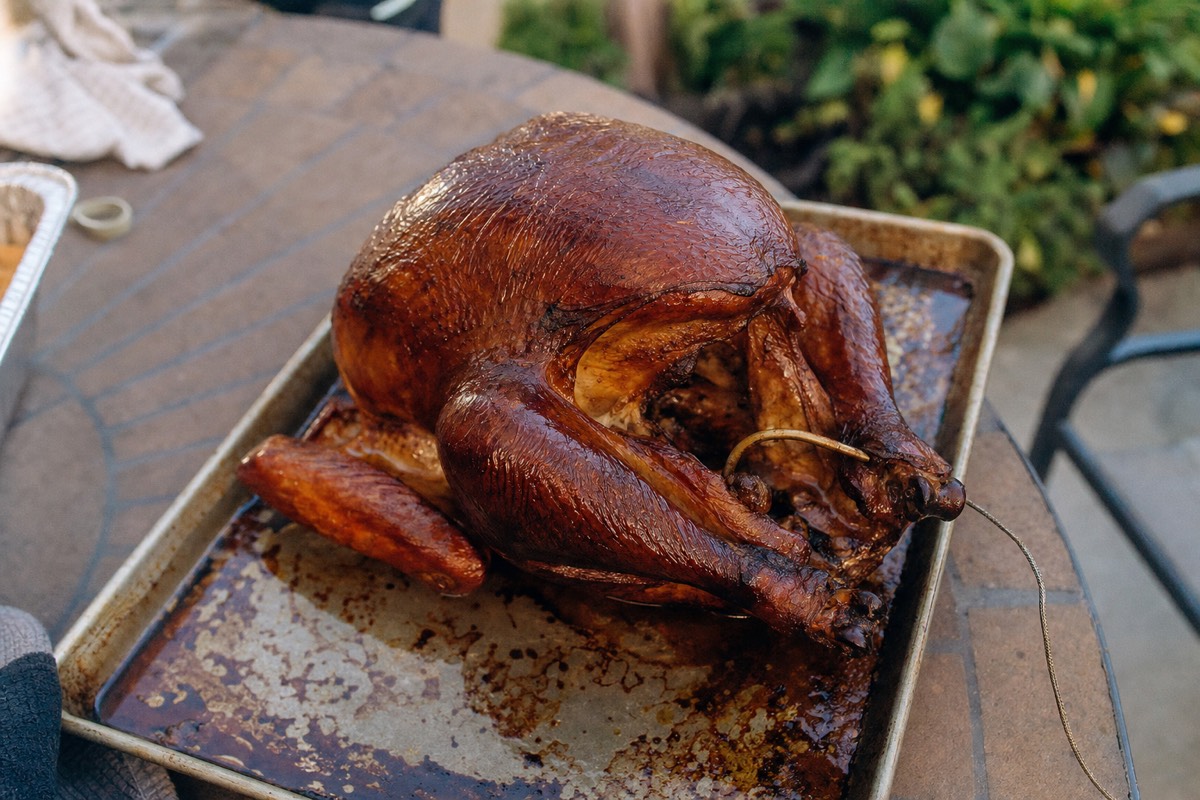
The first turkey I smoked on a pellet grill came off looking like a trophy and eating like a jacket. November 2021, a 14 pound bird, eight patient hours at 225. The skin was deep mahogany and completely rubber. My kids peeled it off in sheets and left it stacked on the side of their plates like packaging. Since then I have put a turkey through nearly every grill in my shed each fall for the OleGrill channel, and the lesson has not budged: turkey is not brisket. It wants more heat than you think, salt a day early, and a thermometer you trust.
How long does a turkey take on a pellet grill?
A whole turkey needs roughly 30 to 35 minutes per pound at 225, 20 to 25 at 275, and 13 to 15 at 325. A 12 pound bird lands at six to seven hours low and slow, or under three at roast temperature. Always cook to 165 internal, never to the clock.
Turkey is one of the faster big cooks you can run, because unlike a brisket there is no stall worth naming. No thick collagen to break down, no wrapping decision at hour six. The bird climbs steadily, which makes the per-pound math unusually trustworthy as a planning tool.
| Pit temp | Minutes per pound | 12 lb whole bird | 16 lb whole bird | Skin result |
|---|---|---|---|---|
| 225 | 30 to 35 | 6 to 7 hours | 8 to 9.5 hours | Soft, usually rubbery |
| 275 | 20 to 25 | 4 to 5 hours | 5.5 to 6.5 hours | Mostly rendered, light crisp |
| 325 | 13 to 15 | 2.5 to 3 hours | 3.5 to 4 hours | Crisp, roast-style |
Two warnings hide inside that table. First, big birds and low temps are a bad pair: a 16 pounder at 225 spends a long time creeping through the bacterial danger zone, so if you insist on smoking low, keep the bird at 14 pounds or under, or split the difference and run 275. Second, never stuff a smoked turkey. The cavity is the last place heat reaches, and stuffing has to hit 165 on its own, per the USDA safe temperature chart. By the time a packed cavity gets there, the breast around it is sawdust. Cook the dressing in a pan and keep the cavity for aromatics.
Is it better to smoke a turkey at 225 or 250?
Neither is my pick. 225 gives the deepest smoke but leaves the skin rubbery, and 250 barely fixes that. Between 250 and 300, go 300: poultry takes on smoke fast, and the hotter pit actually renders the fat in the skin. I run turkey at 275 to 300 every time.
Here is the honest physics. Turkey skin is thin fat over thin protein, and below roughly 275 that fat softens without rendering. You get the texture of a wet raincoat no matter how pretty the color is. It is the exact problem I hit with whole chicken, just spread over a bigger canvas and a longer cook, which makes it worse.
The counterargument for 225 is smoke flavor, and it is a real argument, just an overrated one. Poultry is not brisket bark. The meat takes on smoke quickly because the skin is thin and the flesh is mild, so a 12 pound bird gets plenty of wood character in a three hour 300 degree cook. Doubling the cook time to chase more smoke gains you maybe a shade of flavor and costs you the entire skin.
So when people ask me 250 versus 300, my answer is 300 without hesitation. If your grill has a smoke-boost mode that only works at low temps, run the first hour there, then step up to 300 to finish. That split gets you most of the low-temp flavor and all of the high-temp skin. The one case where I stay low the whole way is turkey breast cooked skin-off for slicing, where texture is not on the line.
Should you spatchcock a turkey for a pellet grill?
Yes, spatchcock anything over 12 pounds. Cutting out the backbone and flattening the bird trims the cook by a third or more, exposes more skin to the heat, and lets breast and thigh finish closer together. The only real costs are rack space and the classic table presentation.
A whole trussed turkey is a shape problem. The thighs hide against the body, the breast stands tall in the airflow, and the two finish on completely different schedules. That is why so many smoked turkeys have perfect legs and chalk breast. Flattening the bird puts everything on one level and roughly one timeline.
| Whole bird | Spatchcocked | |
|---|---|---|
| Cook time, 12 lb at 275 | 4 to 5 hours | About 3 hours |
| Breast vs thigh finish | Breast often overshoots waiting on the thighs | Within a few degrees of each other |
| Skin exposure | Top and sides only | Nearly all of it faces the heat |
| Grate footprint | Compact but tall | Wide, claims most of a standard main grate |
| Presentation | Whole centerpiece at the table | Flat, so carve in the kitchen |
| Extra work | None | Five minutes with poultry shears |
The technique itself is not delicate. Flip the bird breast down, cut along both sides of the backbone with shears, flip it back, and press hard on the breastbone until it cracks flat. Save the backbone for gravy stock. On the grill, run it breast up, legs pointed toward the hotter end of the grate, because dark meat forgives heat that white meat does not.
The footprint is the one thing to check before you commit. A flattened 14 pounder is wide, and on a smaller pit it will crowd the edges where temps run hot. If your grate is tight, either size down the bird or cook it whole at 300 and accept the longer ride.
Which pellet grill handles a whole turkey best?
The Traeger Woodridge Pro is my turkey pick: real headroom for a tall whole bird, a controller that sat steady through cold November air in my tests, and easy access for probing both sides. Our overall site winner, the Weber Searwood XL, cooks turkey well too, but the Woodridge Pro is the one I load for this job.
Turkey stresses a pellet grill in ways burgers never will. It is a November cook in most of the country, so the pit is fighting wind and freezing air for hours. The bird is tall, so lid clearance matters. And because you are chasing 165 in three separate spots, you want a grill you can open, probe, and close without the temperature falling off a cliff.
The Woodridge Pro handled all three better than anything else I ran birds on last season. It recovered fast after lid opens, held its set point in weather that had me wearing gloves, and took a spatchcocked bird without crowding. If you are shopping before the holiday rush, check the current price, and see where it landed against the whole field in our pellet grill rankings.
Fair balance: the Searwood XL remains our top pick overall, and if you already own it, do not buy anything new for turkey day. The Woodridge Pro earns the turkey nod on clearance, cold-weather steadiness, and price, not because the alternatives fail.
Do you need to brine a turkey before smoking?
You do not have to brine, but a dry brine is the cheapest insurance you can buy. Salt the bird a day or two ahead and the breast holds moisture through the smoke. Wet brines work too, though they demand fridge space and can soften the skin. Skip brining only on pre-basted birds.
Turkey breast is lean, and lean meat on a smoker dries out between the moment it is done and the moment you believe your thermometer. Salt ahead of time changes the protein so it grips its own moisture, which widens your margin for error. That margin is the whole point.
| Method | What it takes | Moisture | Skin | My verdict |
|---|---|---|---|---|
| Dry brine | About 1/2 teaspoon kosher salt per pound, 24 to 48 hours uncovered in the fridge | Very good | Dries the surface, best crisp of the three | What I do every single year |
| Wet brine | 1 cup kosher salt per gallon of water, 12 to 24 hours fully submerged, a cooler or stockpot | Excellent | Waterlogged unless you air-dry the bird overnight after | Worth it for lean heritage birds |
| No brine | Nothing | Breast fades fast past 160 | Fine | Only for pre-basted supermarket birds |
The uncovered part of the dry brine matters as much as the salt. Two days on a rack in the fridge dries the skin to a papery surface, and dry skin is the setup that lets a 300 degree pit crisp it. A wet-brined bird arrives at the grill soggy, which is why wet brine plus low smoke is the classic recipe for rubber.
One check before you salt anything: read the label. Most frozen supermarket turkeys are pre-basted, meaning injected with a salt solution at the plant. Brining one of those stacks salt on salt, and the result eats like deli meat. Pre-basted birds get rub only at my house, and the rub is low-salt.
What internal temperature is a smoked turkey done at?
A smoked turkey is done at a minimum of 165 measured in the thickest part of the breast, the innermost thigh, and the innermost wing, per the USDA safe temperature chart. Check all three spots with a probe thermometer. Color, clocks, and pop-up timers are not evidence; the number is.
The three-spot check is the part people skip, and it is the part that matters. A leave-in probe in the breast can read 165 while the deep thigh joint sits ten degrees behind, especially on a whole trussed bird where the thighs are tucked out of the airflow. The USDA chart is blunt about it: 165 in the thickest part of breast, thigh, and wing, verified with a food thermometer, and that standard applies to smoked birds exactly as it does to oven-roasted ones.
My probing routine is quick. When the leave-in breast probe shows 160, I open the lid once with an instant-read in hand and hit five spots in about twenty seconds: both deep breasts, both thigh joints, one wing. The lowest number is the bird's real temperature. If everything but one thigh is done, I point that thigh at the hot side and give it fifteen more minutes rather than cooking the whole bird longer.
One more trick smoke plays: the meat near the surface stays pink even when fully cooked. That rosy ring is a reaction with the smoke, not undercooking. Trust the thermometer over your eyes, in both directions, then rest the bird before carving.
What pellets are best for smoked turkey?
Cherry and apple are my defaults: mild, slightly sweet, and cherry pushes that deep mahogany color. Hickory works if your crowd likes a bolder smoke, and a hickory-cherry blend splits the difference. I skip mesquite on poultry, since it turns acrid over a multi-hour cook on mild meat.
Can I smoke a turkey overnight at low temperature?
No. An overnight bird at 180 or 200 spends far too long between 40 and 140, which is the bacterial danger zone, and poultry is the last meat to gamble with. Turkey cooks fast enough that there is no reason to run it while you sleep. Start at breakfast, eat by mid-afternoon.
How long does a frozen turkey take to thaw before smoking?
In the fridge, plan about 24 hours for every 4 to 5 pounds, so a 15 pound bird needs three to four full days. Never thaw on the counter, and never put a partially frozen bird on the grill, because the frozen core wrecks both the timing and the safety math.
How long should a smoked turkey rest?
Twenty to thirty minutes under a loose foil tent. Wrap it tight and the skin you spent the whole cook crisping steams soft in minutes. The bird holds heat far longer than people expect, so there is no rush to carve, and the wait pays you back in juice retained per slice.
Is it better to smoke two small turkeys than one big one?
For a crowd, yes. Two 10 to 12 pound birds cook faster than one 20 pounder, spend less time in the danger zone, and give you four drumsticks instead of two. If your grate can hold them with a few inches of spacing, twin birds beat one giant almost every time.